What are Mantodea?
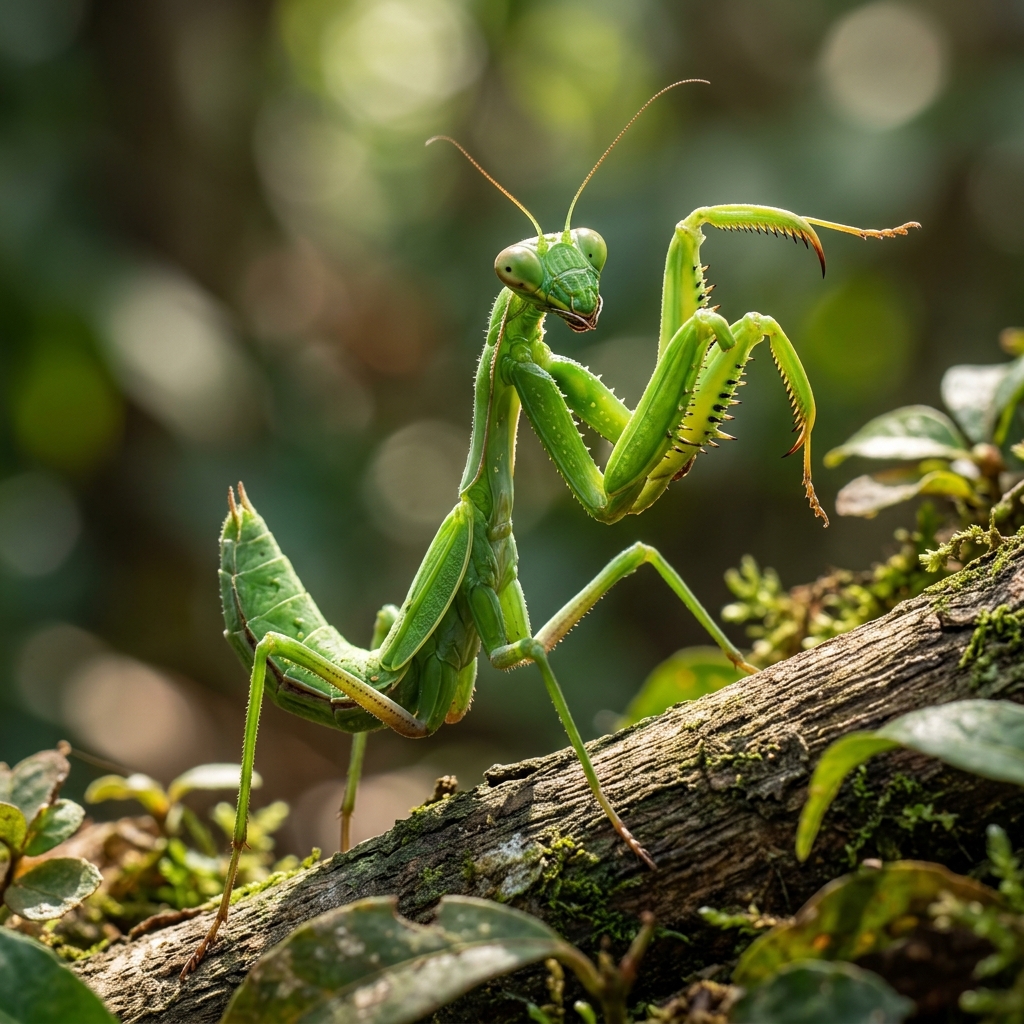
The order Mantodea contains approximately 2,400 species of praying mantises, found across tropical and temperate regions worldwide. Their name derives from the Greek "mantis" meaning prophet or seer — inspired by their contemplative prayer-like posture as they hold their raptorial forelegs folded in front of them.
Mantises are the only insects capable of turning their heads to look over their "shoulder" — a 180° rotation enabled by a flexible joint between the head and prothorax. Combined with stereoscopic vision from their two large compound eyes, this gives them exceptional depth perception for judging strike distance.
Key Characteristics
- Raptorial forelegs: Modified grasping legs armed with spines that snap shut on prey in 50-70 milliseconds — faster than a human blink.
- Triangular head: Unique among insects, with the ability to rotate 180° for an almost complete field of view.
- Binocular vision: The only invertebrates known to have stereoscopic 3D vision, recently confirmed by researchers using tiny 3D glasses.
- Masters of camouflage: Many species perfectly mimic leaves, flowers, bark, or twigs. The orchid mantis (Hymenopus coronatus) is so convincing that it actually attracts pollinators better than real flowers.
- Sexual cannibalism: Females of some species may consume the male during or after mating — though this behavior is less common in the wild than in captivity.
Notable Species
- Chinese mantis (Tenodera sinensis): One of the largest mantis species at up to 11cm. Widely introduced to North America for pest control.
- European mantis (Mantis religiosa): The species that gave the order its common name. Distributed across Europe, Asia, and North America.
- Orchid mantis (Hymenopus coronatus): Southeast Asian species with lobed leg segments resembling flower petals. One of nature's most spectacular examples of aggressive mimicry.
- Ghost mantis (Phyllocrania paradoxa): African species resembling a dried, withered leaf — camouflage so effective they become virtually invisible among dead foliage.
- Giant Asian mantis (Hierodula membranacea): Large, robust species popular in the pet trade. An active, aggressive hunter.
Ecological Role
Mantises are generalist predators consuming a wide variety of insects, including pest species, making them valuable for natural pest control. Large species have been documented catching hummingbirds, small frogs, lizards, and even snakes. They are also important prey for birds and bats.