What are Odonata?
The order Odonata ("toothed ones," referring to their serrated jaws) contains roughly 6,000 species of dragonflies and damselflies. These ancient insects are among the most efficient aerial predators in the animal kingdom, catching up to 95% of the prey they pursue — making them more successful hunters than lions, sharks, or eagles.
During the Carboniferous period, their ancestors grew to enormous sizes. The Meganeuropsis had a wingspan of 71cm (28 inches) — the largest insect ever known to exist. While modern species are smaller, they retain the same fundamental design that made their ancestors so successful.
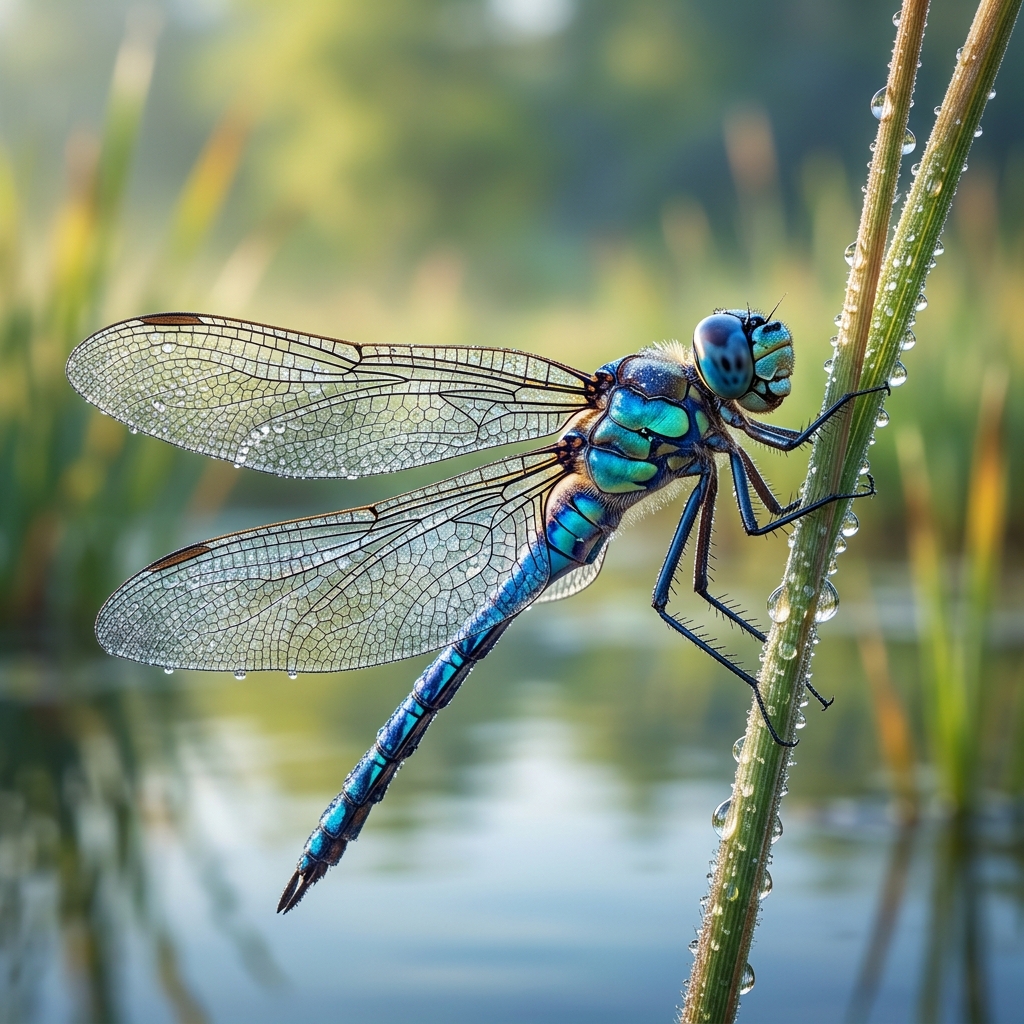
Dragonflies vs. Damselflies
- Wings at rest: Dragonflies hold wings horizontally when perched. Damselflies fold wings along their body.
- Body shape: Dragonflies have robust, stocky bodies. Damselflies are slender and delicate.
- Eyes: Dragonfly eyes are large and nearly touch. Damselfly eyes are separated by more than an eye's width.
- Flight: Dragonflies are strong, fast fliers. Damselflies have a softer, more fluttery flight pattern.
- Hindwing shape: Dragonfly hindwings are broader at the base. Damselfly wings are similar in shape.
Incredible Flight Capabilities
Dragonflies possess four independently-controllable wings that allow them to:
- Hover motionless in mid-air
- Fly backwards — one of very few insects capable of this
- Fly sideways and make instant 90° turns
- Reach speeds of up to 56 km/h (35 mph)
- Accelerate at up to 4g — four times the force of gravity
This extraordinary flight performance is possible because each wing is powered by separate muscles, and the wings can be independently angled, rotated, and phased — essentially giving dragonflies four-dimensional flight control.
Life Cycle
Odonata have a unique lifecycle tied intimately to water. Unlike most insects, they undergo incomplete metamorphosis — there is no pupal stage:
Eggs are laid in or near water. Nymphs (also called naiads) are fully aquatic predators that breathe through gills and can spend 1-5 years underwater. They are fierce underwater hunters, using a unique extensible jaw (labium) that shoots forward to snare prey at lightning speed.
When ready, the nymph climbs out of water, and the adult dragonfly emerges from the nymphal skin — one of nature's most dramatic transformations.
Ecological Role
Dragonflies are voracious predators of mosquitoes and other flying insects — a single dragonfly can eat hundreds of mosquitoes per day. They are also excellent bioindicators — their presence indicates healthy freshwater ecosystems. Many species are sensitive to pollution, making them valuable monitors of water quality.