What are Coleoptera?
Beetles belong to the order Coleoptera ("sheath-winged"), named for their hardened forewings called elytra that form a protective shell over the flight wings. This armor-like innovation has allowed beetles to colonize virtually every habitat on Earth except the open ocean.
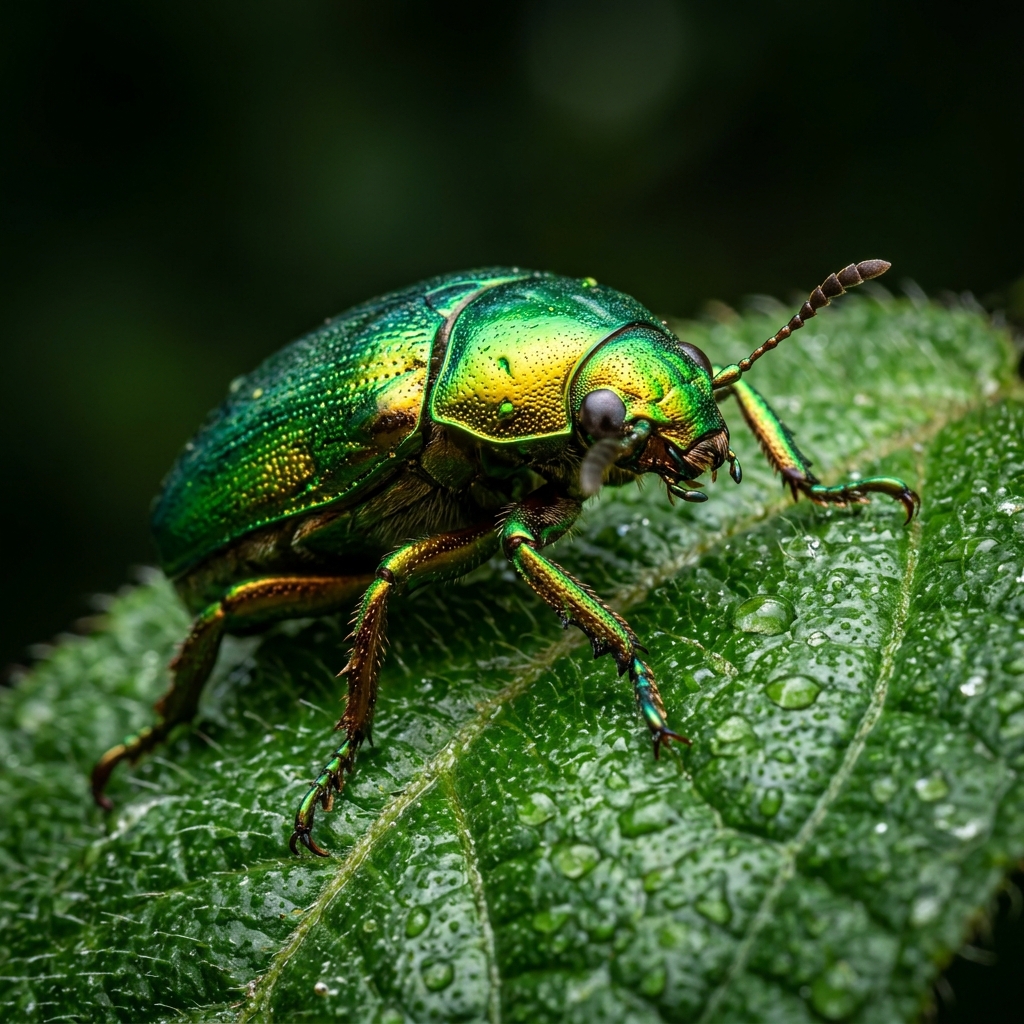
Complete Beetle Family Guide
Predatory & Aquatic Beetles
- Ground beetles (family Carabidae): Over 40,000 species of mostly predatory beetles. Fast runners that patrol the soil surface at night hunting pest insects. Valuable allies in agriculture and gardening.
- Tiger beetles (family Cicindelidae): Among the fastest insects relative to body size — some species run at 9 km/h (5.6 mph), equivalent to a human running 480 km/h. Metallic, iridescent, with large sickle-shaped mandibles.
- Predaceous diving beetles (family Dytiscidae): Streamlined aquatic beetles that trap air bubbles under their elytra for breathing underwater. Voracious predators that even attack small fish and tadpoles.
- Whirligig beetles (family Gyrinidae): Spin rapidly on the water surface. Their compound eyes are divided — the upper half sees above water, the lower half below — giving them simultaneous aerial and aquatic vision.
- Water scavenger beetles (superfamily Hydrophiloidea): Primarily aquatic, carrying a silvery air film on their ventral surface for respiration. Adults are mostly herbivorous, while larvae are predators.
Wood-Boring & Bark Beetles
- Long-horned beetles (family Cerambycidae): Named for extraordinarily long antennae. Larvae bore through wood.
- Asian longhorned beetle (Anoplophora glabripennis): Invasive pest destroying millions of trees in North America and Europe.
- Harlequin beetle (Acrocinus longimanus): Spectacular tropical species with elaborate markings and elongated front legs.
- Metallic wood-boring beetles (family Buprestidae): Brilliantly metallic beetles whose larvae bore under bark.
- Emerald ash borer (Agrilus planipennis): Asian invasive that has killed hundreds of millions of ash trees in North America since its discovery in 2002.
- Bark-gnawing beetles (family Trogossitidae): Predators living under bark, feeding on other wood-boring insects.
- Borer beetles / Deathwatch beetles (family Anobiidae): Wood-boring beetles whose tapping mating calls were once superstitiously associated with impending death. Includes spider beetles.
- Branch and twig borers (family Bostrichidae): Bore into branches, twigs, and stored wood products.
- Powderpost beetles (subfamily Lyctinae): Reduce dry hardwood to fine powder. Major pests of furniture, flooring, and structural timber.
Leaf Beetles & Plant Feeders
- Leaf beetles (family Chrysomelidae): Over 35,000 species — one of the largest beetle families.
- Asparagus beetles (genera Crioceris and Lema): Including the three-lined potato beetle (Lema trilineata).
- Casebearing leaf beetles (subfamilies Cryptocephalinae and Lamprosomatinae): Larvae construct portable cases from fecal material for protection.
- Cobalt milkweed beetle (Chrysochus cobaltinus): Brilliant metallic blue beetle of western North America.
- Dogbane beetle (Chrysochus auratus): Iridescent copper-green beetle feeding on dogbane plants.
- Colorado potato beetle (Leptinotarsa decemlineata): Yellow with black stripes — one of the most destructive agricultural pests worldwide. Has evolved resistance to over 50 different insecticides.
- Cucumber beetles (genus Diabrotica): Major pests of cucurbits and corn; larvae (corn rootworms) cause billions of dollars in crop losses annually.
- Flea beetles (subfamily Alticinae): Named for their enlarged hind legs that allow them to jump like fleas when disturbed.
- Tortoise beetles (subfamily Cassidinae): Shaped like tiny turtles with wide, flat margins. Some species can change color — the golden tortoise beetle shifts from gold to reddish-brown when disturbed.
- Fruitworm beetles (family Byturidae): Larvae feed inside developing fruits, particularly raspberries.
Scarab Beetles (family Scarabaeidae)
One of the most diverse and iconic beetle families, revered since ancient Egypt:
- Chafers (subfamily Melolonthinae):
- Cockchafers (Melolontha melolontha): Large European beetles whose grubs feed on plant roots for 3-4 years before pupating.
- June beetles (genus Phyllophaga): Familiar nocturnal visitors to porch lights. Over 900 species in North America alone.
- Flower chafers (subfamily Cetoniinae):
- African goliath beetle (Goliathus goliatus): One of the heaviest insects on Earth — adults can weigh over 100 grams, about as heavy as an apple.
- Rhinoceros beetles (subfamily Dynastinae):
- Eastern Hercules beetle (Dynastes tityus): Males sport spectacular horns used in combat. Can lift 850 times their own body weight — proportionally the strongest animal on Earth.
- Shining leaf chafers (subfamily Rutelinae):
- Japanese beetle (Popillia japonica): Invasive pest in North America that feeds on over 300 plant species as adults and roots as grubs.
- Dung beetles (subfamily Scarabaeinae): Roll balls of dung up to 10× their body weight. Navigate using the Milky Way — the first animals proven to use the stars for orientation. Sacred to ancient Egyptians as the scarab symbol.
Beneficial & Household Beetles
- Ladybugs (family Coccinellidae): Beloved spotted beetles. A single ladybug can consume up to 5,000 aphids in its lifetime. Some species are used commercially for biological pest control.
- Fireflies (family Lampyridae): Bioluminescent beetles producing light through luciferin/luciferase chemical reactions. Each species has a unique flash pattern for mate recognition. Some femmes fatales mimic other species' flashes to lure and eat males.
- Soldier beetles (family Cantharidae): Soft-bodied predatory beetles often found on flowers. Important pollinators and pest controllers.
- Rove beetles (family Staphylinidae): Short-elytra beetles exposing flexible abdomens. Over 63,000 species — the second-largest beetle family. Many are predators of pest insects.
- Click beetles (family Elateridae): Named for their snap-jumping mechanism — when flipped on their backs, they arch and "click" themselves into the air with an audible snap. Larvae (wireworms) are agricultural pests.
- Checkered beetles (family Cleridae): Predators of wood-boring beetles. Brightly colored with hairy bodies.
Scavenger & Fungus Beetles
- Carrion beetles (family Silphidae): Burying beetles bury small animal carcasses underground as food for their larvae — one of the few insect groups showing parental care.
- Dermestid beetles (family Dermestidae): Feed on dried animal products — museums use them to clean skeletons. Also pests of stored foods, furs, and natural fiber collections.
- Darkling beetles (family Tenebrionidae): Diverse family including mealworms (a common feeder insect). Many desert species have evolved fog-basking behavior for water collection.
- Hairy fungus beetles (family Mycetophagidae): Small beetles feeding on fungi growing on decaying wood.
- Pleasing fungus beetles (family Erotylidae): Colorful beetles associated with bracket fungi on trees.
- Silken fungus beetles (family Cryptophagidae): Tiny beetles feeding on mold and fungi in leaf litter.
- Flat bark beetles (family Cucujidae): Extremely flattened beetles living under bark.
- Flat grain beetles (family Silvanidae): Pests of stored grain and food products.
- Sap beetles (family Nitidulidae): Attracted to fermenting sap, overripe fruit, and fungi.
- Hister beetles (family Histeridae): Shiny, compact predatory beetles found in dung, carrion, and under bark.
- Skin beetles (family Trogidae): Feed on dried skin and hair of animal remains — the last scavengers to visit a carcass.
- Bess beetles (family Passalidae): Subsocial beetles living in rotting wood. Adults and larvae communicate through stridulation and show parental care.
- Feather-winged beetles (family Ptiliidae): Among the smallest beetles (some under 0.5mm). Named for their fringed, feather-like hindwings.
Specialty Beetles
- Blister beetles (family Meloidae): Produce cantharidin, a blistering compound. Historically infamous as the source of "Spanish fly." Undergo hypermetamorphosis with multiple larval stages.
- Stag beetles (family Lucanidae): Males sport enlarged mandibles used in combat over mates. Some mandibles rival the beetle's body length. Larvae develop in rotting wood for up to 6 years.
- Antlike flower beetles (family Anthicidae): Small ant-mimicking beetles found on flowers and leaf litter.
- Lizard beetles (family Languriidae): Elongated beetles whose larvae bore into plant stems.
- Oedemerid beetles (family Oedemeridae): Soft-bodied beetles found on flowers. Some species contain cantharidin.
- Tumbling flower beetles (family Mordellidae): Named for their habit of tumbling off flowers when disturbed. Pointed abdomens and humped thorax.
- Leaf-rolling weevils (family Attelabidae): Cut and roll leaves into precise cylinders as brood chambers for their larvae.
True Weevils (family Curculionidae)
The largest animal family by species count, with over 60,000 described species. All weevils have a distinctive elongated snout (rostrum):
- Alfalfa weevil (Hypera postica): Major pest of alfalfa crops worldwide.
- Bark beetles (subfamily Scolytinae): Bore galleries under bark, often vectoring devastating tree diseases. Mountain pine beetles have destroyed millions of acres of forest.
- Billbugs (subfamily Rhynchophorinae): Pests of grass and palm. The red palm weevil threatens date palm plantations globally.
- Boll weevil (Anthonomus grandis): Devastating cotton pest that cost the US cotton industry billions and reshaped southern agriculture.
- Acorn and nut weevils (genus Curculio): Females drill holes in developing acorns and nuts to lay eggs inside.
- Plum curculio (Conotrachelus nenuphar): Major pest of stone fruits, creating crescent-shaped egg scars on developing fruit.
- Grain weevil (Sitophilus granarius): Destroys stored grain. Each female can lay 250 eggs, with larvae developing entirely inside individual grain kernels.
- Fungus weevils (family Anthribidae): Broad-nosed weevils feeding on fungi, dead wood, and seeds.